

Finalizing Books of Accounts with a GST Perspective: A Practical Guide for SMEs and Corporates
Year-end closing is no longer just an accounting exercise. A step-by-step guide for SMEs and corporates in India — GSTR-1/3B/2B reconciliations, ITC and RCM checks, 26AS/AIS matching, Schedule III statements, and the Board/AGM/ROC calendar that follows.
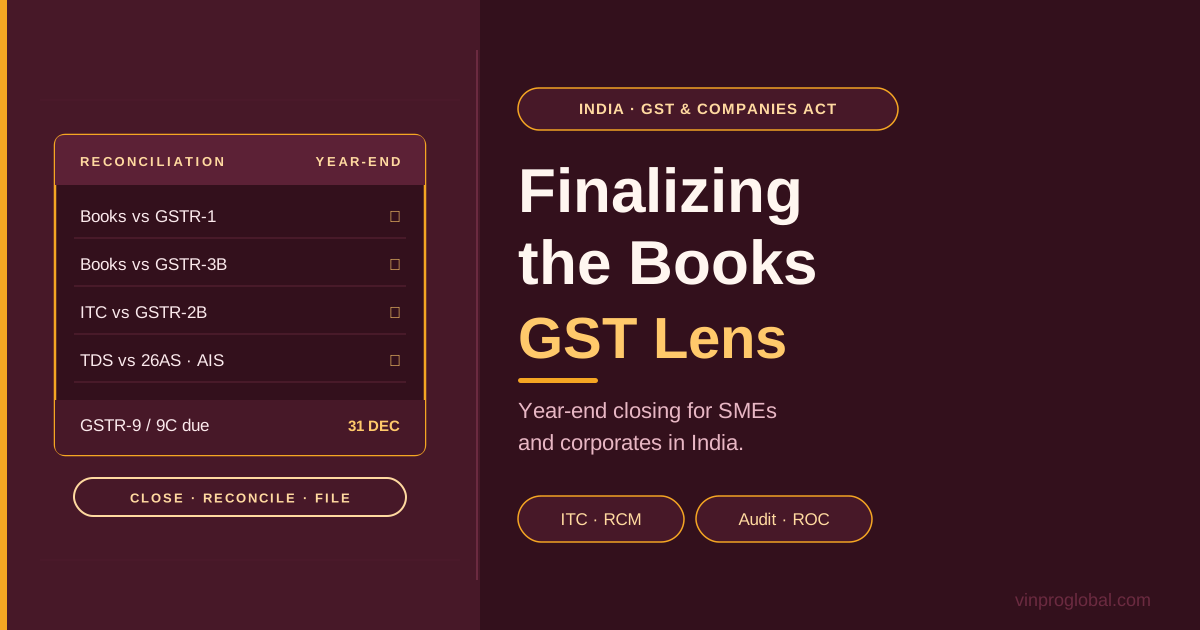
Finalizing books of accounts at year-end (typically 31 March) is a critical process for every business. It ensures accurate financial statements, seamless tax compliance, and avoidance of penalties. For small and medium enterprises (SMEs) and especially private limited companies, this involves aligning books with GST rules, Income Tax provisions, and corporate laws under the Companies Act, 2013.
Proper finalization helps present a true and fair view, supports audits, and prevents issues during assessments or GST scrutiny. Delays or errors can lead to interest, penalties, and qualifications in audit reports. This guide provides a practical, step-by-step approach tailored for SMEs and corporates.
1. Why Timely and Accurate Finalization Matters
- Ensures compliance with multiple laws (GST, Income Tax, Companies Act)
- Enables correct tax computation and claim of benefits (e.g., Input Tax Credit)
- Supports statutory audits and regulatory filings
- Helps in better financial planning and decision-making for the next year
- Reduces risk of notices, demands, and litigation
For corporates, it directly impacts Board approval, the AGM, and ROC filings. For non-corporate SMEs, it is crucial for Income Tax audit (if applicable) and return filing.
2. Preparatory Steps Before Closing Books
Start early (ideally from January–February) to avoid a last-minute rush:
- Complete all routine entries up to 31 March
- Reconcile bank accounts, debtors, creditors, and inter-company balances
- Verify physical inventory and fixed assets
- Record all provisions, accruals, and prepayments (e.g., audit fees, bonuses, outstanding expenses)
- Pass depreciation entries as per Schedule II of the Companies Act (for companies) or Income Tax rules
- Ensure cut-off procedures: all invoices, credit/debit notes, and goods/services for the financial year must be accounted correctly
3. GST Perspective: Key Considerations and Reconciliations
GST compliance is one of the most important aspects during finalization. Discrepancies between books and GST returns can lead to notices or demands.
Essential GST Reconciliations (perform two-way matching)
- Books vs. GSTR-1 (outward supplies/turnover)
- Books vs. GSTR-3B (output liability and ITC claimed)
- ITC in books vs. GSTR-2B (eligible credits)
- GST payable/receivable ledgers with portal balances (Electronic Credit Ledger and Cash Ledger)
- Turnover reconciliation across multiple GSTINs under the same PAN
- Job work records (ITC-04), goods in transit, and deemed supplies
Key GST Areas to Review
- Input Tax Credit (ITC): ensure eligibility under Section 16 (possession of invoice, receipt of goods/services, tax paid by supplier, return filed, and appearance in GSTR-2B). Reverse ineligible/blocked credits under Section 17(5) (e.g., certain motor vehicles, food, outdoor catering, personal-use items) and charge the tax to Profit & Loss as expense
- Reverse Charge Mechanism (RCM): identify and account for RCM liability (e.g., on GTA, legal services, import of services, unregistered suppliers for specified items). Pay and claim ITC where eligible
- Time of Supply & Cut-off: align book revenue recognition with GST time of supply. Handle advances, discounts (via credit notes), and post-supply adjustments correctly
Annual Returns
- GSTR-9 (Annual Return): mandatory if aggregate turnover exceeds ₹2 crore. Due by 31 December of the following year. It consolidates data from GSTR-1, GSTR-3B, and books
- GSTR-9C (Reconciliation Statement): mandatory if aggregate turnover exceeds ₹5 crore. It reconciles audited financial statements with GSTR-9. Self-certified (no external audit required now). Attach audited accounts
Treatment of Differences
Material differences between books and GST returns should generally be adjusted in the subsequent financial year as prior-period items (if material). Finalized accounts are not easily revised. Quantify additional tax liability plus interest in GSTR-9C where applicable.
Interest and penalties: charge interest on late GST payment or delayed ITC reversal (e.g., >180 days unpaid suppliers) and penalties to the Profit & Loss Account under “Rates and Taxes” or “Other Expenses.”
4. Income Tax and Other Statutory Compliances
- Reconcile TDS/TCS deducted and deposited with Form 26AS, AIS, and TIS
- Verify compliance with Section 43B (disallowance of unpaid statutory dues like GST, PF, etc., if not paid before the ITR due date)
- Compute tax liability, including MAT (if applicable), deferred tax, and book vs. taxable profit reconciliation
- For entities requiring Tax Audit (u/s 44AB): turnover thresholds apply (generally >₹1–10 crore for business or >₹50 lakh for profession, with presumptive scheme options)
- Other dues: PF, ESI, Professional Tax — ensure timely deposit and reconciliation
5. Special Requirements for Corporates (Companies Act, 2013)
Private limited companies have additional layers of compliance:
- Prepare Financial Statements strictly as per Schedule III (Division I for Accounting Standards or Division II for Ind-AS, as applicable). Include Balance Sheet, Statement of Profit & Loss, Notes, and Cash Flow Statement (exemptions for small companies in some cases)
- Get accounts audited by a Statutory Auditor (mandatory for all companies)
- Obtain Board approval of financial statements
- Hold the AGM (usually by 30 September) for shareholder approval
- File Form AOC-4 (Financial Statements + Directors' Report + Audit Report) with the ROC — within 30 days of the AGM
- File Form MGT-7 / 7A (Annual Return) — within 60 days of the AGM
Small companies enjoy certain relaxations (e.g., simpler filings), but core requirements remain. Proper GST and tax reconciliations help avoid qualifications in the audit report (e.g., on statutory dues under CARO).
6. Year-End Closing Checklist (Quick Reference)
- Complete bank, ledger, debtor, creditor, and GST reconciliations
- Verify statutory compliances (GST returns filed/paid, TDS, PF/ESI)
- Record all provisions, accruals, and closing entries
- Physically verify inventory and fixed assets; compute depreciation
- Reconcile with external portals (GST, Income Tax 26AS/AIS)
- Prepare draft financial statements and tax computation
- For corporates: arrange statutory audit and Board/AGM approvals
- File GSTR-9 / GSTR-9C (by 31 December) after finalization
7. Common Pitfalls and Best Practices
Pitfalls to Avoid
- Incomplete ITC reconciliation leading to excess claims or missed credits
- Ignoring cut-off for goods in transit or March invoices received in April
- Not reversing blocked/ineligible ITC or RCM liabilities
- Mismatch between book turnover and GSTR-1/GSTR-3B
- Delaying provisions for interest/penalties
Best Practices
- Maintain robust vendor masters with GSTINs and regular reconciliation
- Use accounting software integrated with the GST portal for real-time matching
- Conduct an internal GST review alongside financial closing
- Document all adjustments and reconciliations thoroughly (useful for audits)
- Engage a Chartered Accountant early for complex entities
- For multi-GSTIN or group companies: consolidate and reconcile properly
Conclusion
Finalizing books of accounts with a strong GST and statutory focus is no longer just an accounting exercise — it is a compliance necessity. For SMEs, it ensures smooth Income Tax and GST annual filings. For corporates, it forms the foundation for statutory audit, Board/AGM approvals, and ROC compliance.
— Prepared by Raghavendran T, Vinpro Global.